
"Chinese coffee agriculture"
1000 article(s) found

Coffee: a commodity to be awakened by the Chinese factor
Elegant and romantic Starbucks, mellow cafes. What you may not imagine is that behind the quiet and pleasant scene is the choppy coffee market.
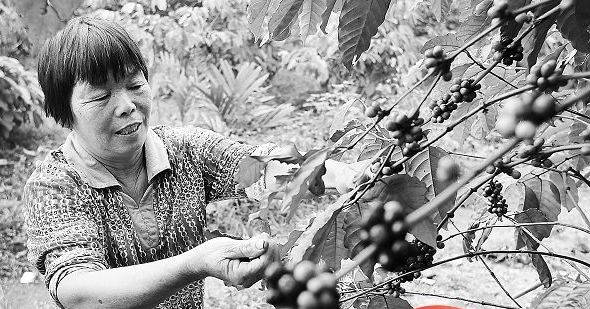
Coffee cold knowledge: Hainan coffee annual output of less than 200 tons, sales reached 6000 tons
Growers at Xinglong Overseas Chinese Farm are checking coffee growth. Reporter Su Xiaojie Photographed by our reporter Kuang Changxun Guo Jiaxuan Special reporter Chen Xunjing Correspondent Wang Zhezhi Fu Ji like a mountain, prosperous prosperity. In the past May Day holiday, Wanning Xing

Chinese Coffee Bean introduces Pu'er 's "Simao small seed Coffee"
Pu'er City is located between 22 degrees 02 to 24 degrees 50 minutes north latitude and 99 degrees 09 minutes to 102 degrees 19 minutes east longitude. Passing through the Tropic of Cancer, Pu'er City is a plateau climate zone with low latitude and humid monsoon climate in the south subtropics. It is in the same latitude as the world-famous coffee growing area Colombia, which is the golden zone of coffee cultivation. Cultivation of Simao small seed Coffee in Pu'er City

Yunnan Pu'er Coffee production area Aizhe Coffee Manor introduction _ what are the recommendations of Pu'er Coffee Brands
For more information on coffee beans, please follow the coffee workshop (official Wechat account cafe_style) No one would have thought of a city famous for its tea and the source of raw materials for Nestl é and Starbucks coffee beans. Pu'er City, Yunnan Province, and Colombia, Jamaica and other famous coffee producing areas at the same latitude. 80% of the Chinese coffee you drink comes from here. Suffer from sub-heat
The History of Coffee introduction and expansion in China in the early stage (3)
1. Investigation on the year of coffee introduction in Hainan Island in 1898 1.1 the age of the early introduction of coffee in Hainan Island is indisputably expressed as 1908 in many local chronicles, agricultural history, agricultural history and various books and periodicals in China. However, the remains of the century-old coffee trees in Hainan Island are still there, and the descendants of the ancient trees are still there. Therefore, the century-old coffee trees that actually exist in Hainan have unequivocally rewritten Hainan.
The first place to grow coffee in China
One of the earliest places to grow coffee in Hainan Province is located in the northwest of Chengmai County in Hainan Province. Haiyu West Line Expressway passes through the area. 50 km from Haikou, capital city. It is the origin of Fushan Coffee, a famous brand in Hainan Province. The coffee in this area was introduced from abroad by Chen Xianzhang, a returned overseas Chinese, in 1935. The natural landscape of leisure resort and the essence of agricultural tourism are concentrated in the area.

The introduction and expansion of Coffee in China in the early stage of Coffee Development (3)
1. Investigation on the year of coffee introduction in Hainan Island in 1898 1.1 the age of the early introduction of coffee in Hainan Island is indisputably expressed as 1908 in many local chronicles, agricultural history, agricultural history and various books and periodicals in China. However, the remains of the century-old coffee trees in Hainan Island are still there, and the descendants of the ancient trees are still there. Therefore, the century-old coffee trees that actually exist in Hainan have unequivocally rewritten Hainan.
Where should China's coffee industry go at the crossroads?
Yunnan net (Reporter Fang Min) China's coffee industry has been under the crackdown of foreign multinational corporations. If foreign companies own a general term and use it as a special commodity name, then large companies like Nestl é, you only need to sit and collect coffee shop partner infringement fees, and China's coffee industry will never rise to prominence. When an industry develops to a certain stage, the public

Alibaba rural e-commerce "Binchuan model" launched Zhukula coffee and sold 6000 orders in 3 days.
Yesterday morning, Li Qinghua, a purchasing agent at the Alibaba e-commerce service station in Xinping Village, Jinniu Town, Binchuan County, was busy helping villagers shop for goods online. Our Binchuan has grapes and oranges, as well as winter peaches and dragon fruits, which is also the birthplace of China's first coffee. If it is exported to more people, they can also try Binchuan's good specialties! Li Qinghua said
Modern Agriculture holds hands with International Coffee Brands
Recently, SUNING Hyundai Agriculture Co., Ltd. and TOMNTOMSLtd from South Korea. Officially sign the contract (pictured) to begin the new journey of international coffee brands to expand the market together. At the event ceremony, the two sides reached a consensus on the coffee industry cooperation of the "TOMNTOMS" brand in the next 10 years. SUNING Modern Agriculture has its general agency in East China.
Comprehensive data of Chinese Coffee Yunnan Simao small seed Coffee
Coffee is an advantageous and characteristic industry in the hot area of our city, and it is also one of the main agricultural products that our city exports to earn foreign exchange. In order to standardize the production technology, product standards and marketing behavior of coffee industry in our city, and improve the standardization level of coffee industry, the comprehensive standard of Pu'er small seed coffee was compiled according to the requirements of GB/T1.1 and GB/T1.2. This section defines the terms and definitions in the initial processing of small seed coffee.

An introduction to the characteristics of fine coffee beans in the manor area
After the first World War, the long-standing dissatisfaction of the Ugandan people with colonial rule finally broke out. A national general strike and rural riots broke out in 1918. In 1919 Buganda launched a democratic movement under the leadership of the Bataka Party and the African Farmers' Union of Uganda. In 1921, Uganda's first national political party, the Ugandan National Congress Party, was established and proposed the implementation of universal suffrage.

Kenyan coffee is highly competitive in the market, and the value chain analysis of coffee
1. Background Coffee is one of the most important agricultural products in international commodity trade. Historically, as early as the 1990s, coffee was the second largest internationally traded commodity after oil. However, due to the imbalance between coffee production, production and sales at different stages, the coffee industry has been in crisis more or less over the past decade. As a
The earliest place in Hainan Province to grow coffee
One of the earliest places to grow coffee in Hainan Province is located in the northwest of Chengmai County, Hainan Province, through the Haiyu West Highway. It is 50 kilometers away from the provincial capital city Haikou. It is the origin of Fushan coffee, a well-known brand in Hainan Province. The coffee in this area was introduced by Chen Xianzhang, an overseas Chinese who returned from the mountains in 1935. The area focuses on the natural landscape of the leisure resort and the essence of agricultural tourism.

Yunnan Aiwei Group will build China's first rainforest ecological coffee farm
Engaged in the coffee industry for nearly 30 years, after Aidan Group successfully brought Yunnan coffee into the international coffee market, in order to further improve the quality of Yunnan coffee, enhance the influence of Yunnan coffee in the international and domestic coffee market, and build a national brand of Chinese coffee, Aiyi Group will rely on the green resource advantage of Yunnan Pu'er and plan to invest 600 million on the basis of the established green circular economy chain.
What's with the "Cuba Blue Mountain" coffee?
Recently, my friends always ask me about the so-called Cuba Blue Mountain, saying that it is said that the beans are as delicious as the Blue Mountains but very cheap. Here in the town of Winnie, let's talk to you about the so-called Cuban Blue Mountain Coffee. I checked. In English, Cuban cuba and Blue Mountain blue mountain are absolutely not related. Why does the Cuban Blue Mountain appear in Chinese?

How about organic coffee powder? how to drink organic coffee? how to drink healthy organic coffee powder? how to cook organic coffee powder?
Professional coffee knowledge exchange more coffee bean information please follow the coffee workshop (Wechat official account cafe_style) this packet of Malongo La Tierra pure Arabica coffee beans is a French Malongo company's excellent flavor beans, it is FR-BIO-01 certified organic coffee powder, and has the French Ministry of Agriculture standard organic agriculture label, but also belongs to

The introduction of Ruili Jingpo Nongxian coffee was recorded in 1914.
In April 1996, compiled by the compilation Committee of Ruili City Chronicles of Yunnan Province, the fifth coffee section on page 383 of Ruili City Chronicles published by Sichuan Dictionary Publishing House recorded that as early as 1914, the Jingpo nationality had been introduced from Myanmar to Nongxian Township for cultivation. The local series of books of the people's Republic of China, Records of Yunnan Province, Volume 39, Records of Land Reclamation, Chapter 3, Section 2, Coffee is recorded: the cultivation of coffee in China began in 1884.

History of introduction and expansion of Coffee in early China (1)
1. The introduction of Ruili Jingpo Nongxian Coffee was recorded in 1914. In April 1996, it was compiled by the compilation Committee of Ruili City Chronicles of Yunnan Province. The fifth coffee section on page 383 of Ruili City Chronicles published by Sichuan Dictionary Publishing House recorded that as early as 1914, the Jingpo people have been introduced from Myanmar to Nongxian Township for cultivation. Yunnan Provincial Chronicles, Volume 39, Chapter 3 of the Local Series of the people's Republic of China

Chinese enterprises will build Asia's largest original coffee base and industrial park in Laos
According to Yin Xinhua, the two companies will use the coffee project as a starting point to consolidate and develop coffee bases and speed up the construction of primary processing plants in northern Laos. In the future, we also plan to build a 10,000-ton coffee processing plant in Vientiane City, increase investment in southern Laos, help small and medium-sized coffee enterprises to increase production, and take advantage of coffee trading center and Chongqing New Europe transportation advantages to promote Laos coffee exports to earn foreign exchange.